The comprehension bottleneck
Most of what your editors do isn't editing.
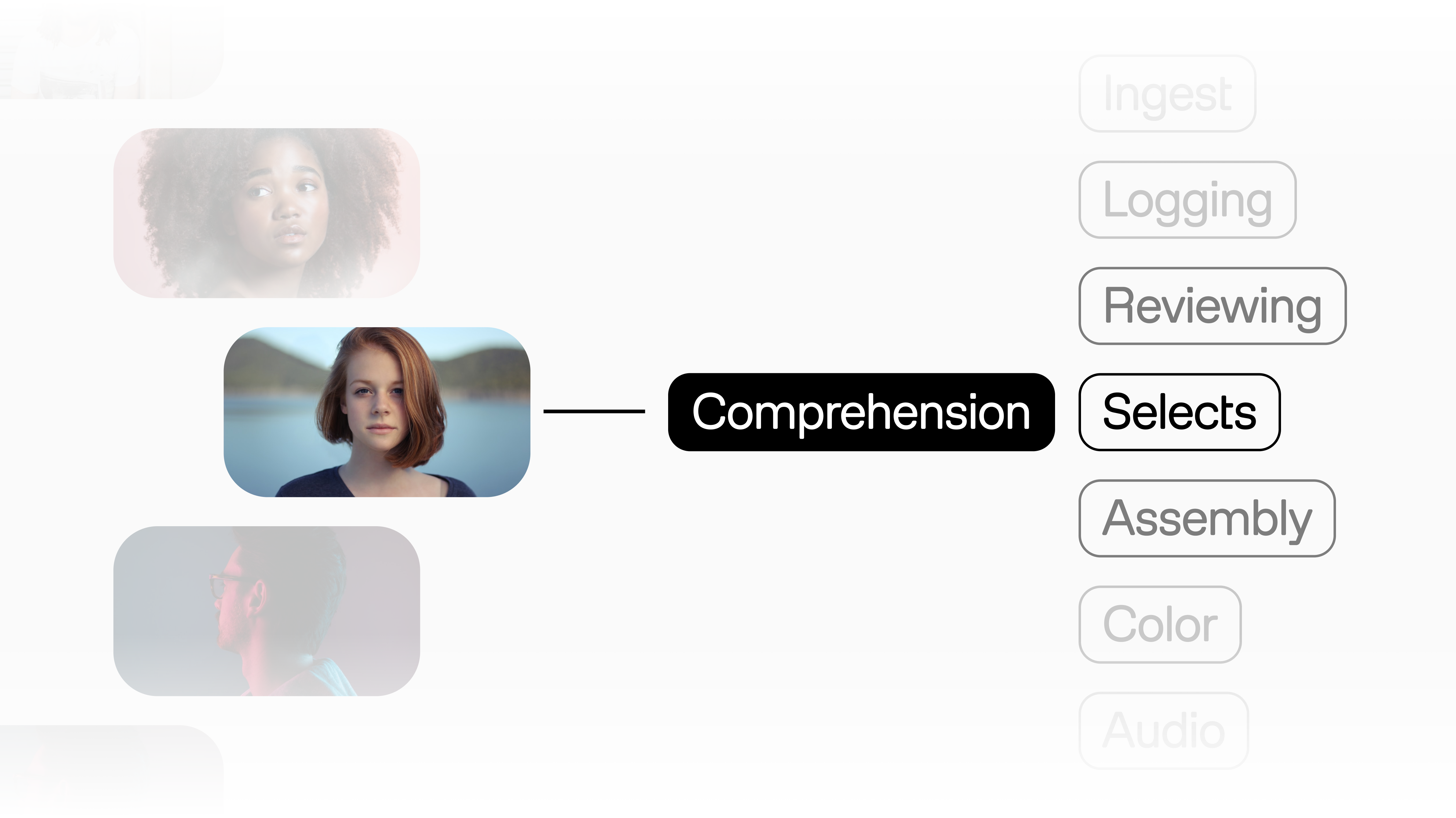
Walk into any mid-size post-production operation on a Tuesday afternoon and the work in progress looks nothing like the work everyone thinks they're paying for. The assistant editors are not creating. They are logging. The editors are not cutting. They are scrubbing. The producers are not producing. They are watching dailies on 1.5x. Somewhere between 60% and 80% of the hours that flow through a post-production pipeline are not creative labor. They are comprehension labor — the long, quiet, expensive act of figuring out what is in the footage.
This is not new. The shape of post-production was set in 1989, when Avid shipped the first commercial non-linear editor and let editors make cuts without physically splicing tape. Random-access editing reorganized the industry around the assumption that the binding constraint was the cut. Everything since — proxy workflows, networked storage, MAM systems, transcript search — has been a thirty-year project to chip away at that constraint while leaving the deeper one untouched. Comprehension still costs an hour for every hour of footage. The cut got cheap. Watching never did.
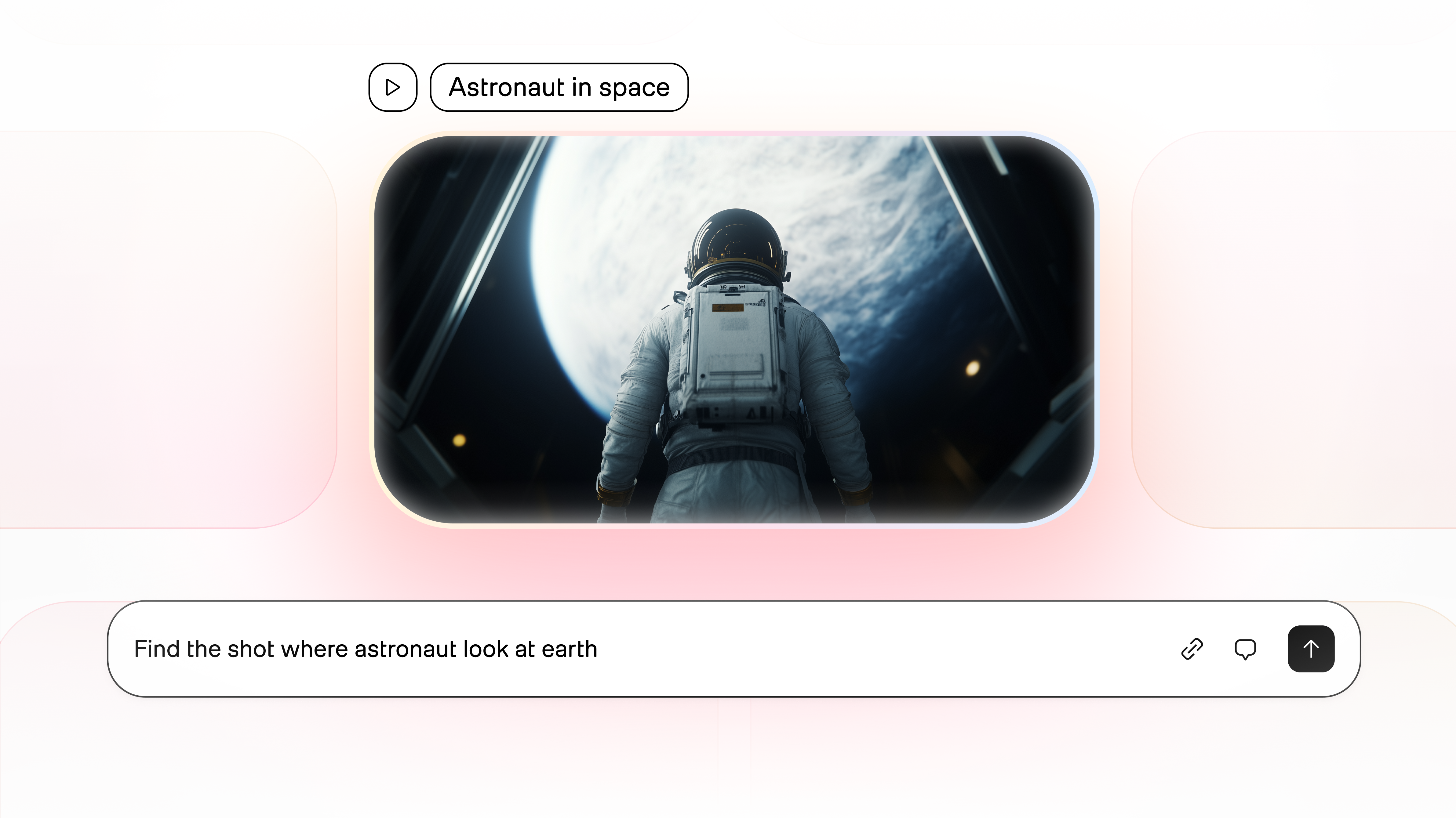
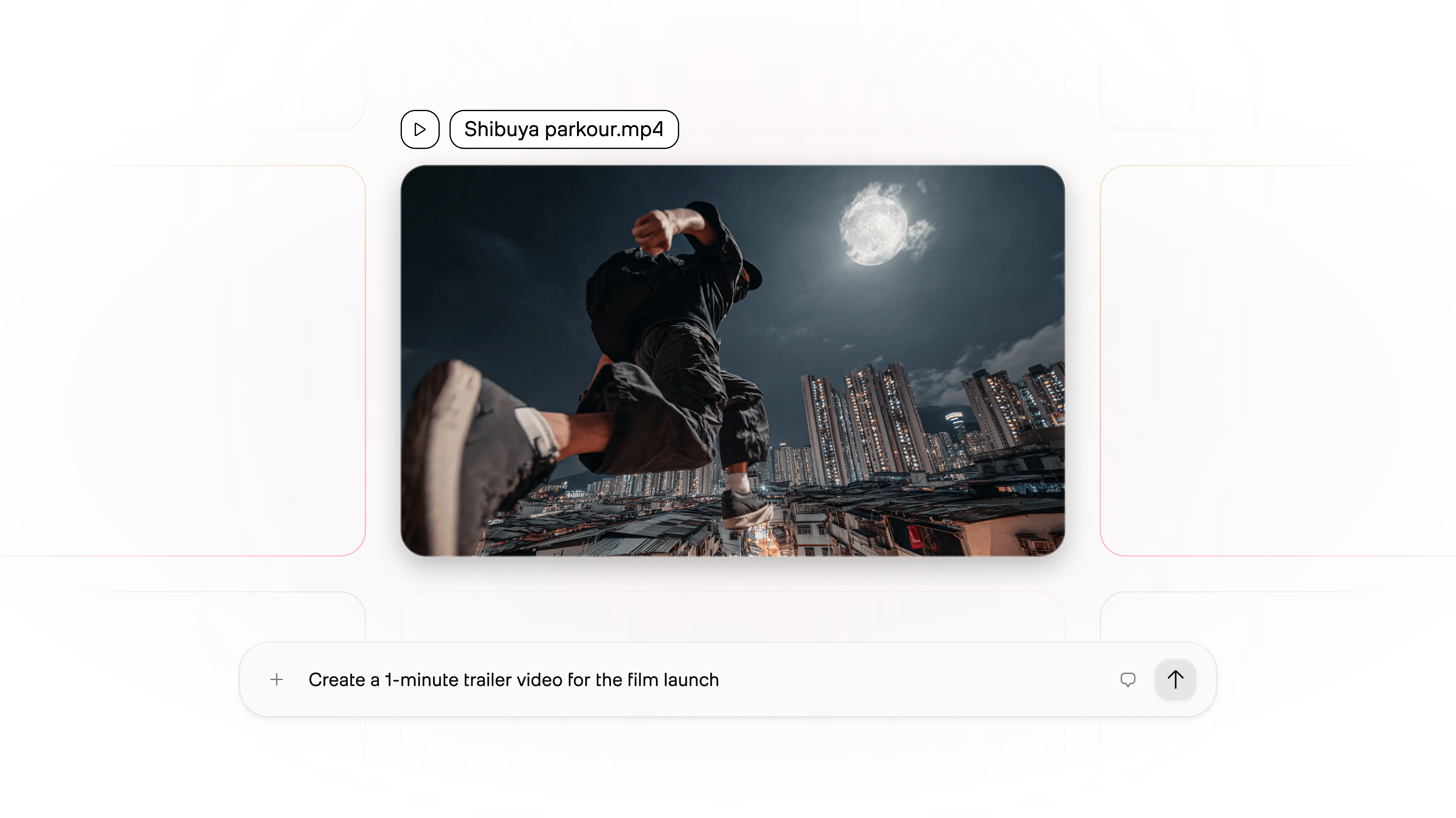
The comprehension bottleneck the industry has priced as fixed is now addressable with Rodeo — now generally available. Powered by TwelveLabs, Rodeo is an AI video intelligence platform that understands your footage, so you can go from raw clips to a first cut using plain language without searching, scrubbing, or organizing a single folder. What used to take hours of manual review now takes minutes of structured creation.
Where the hours actually go
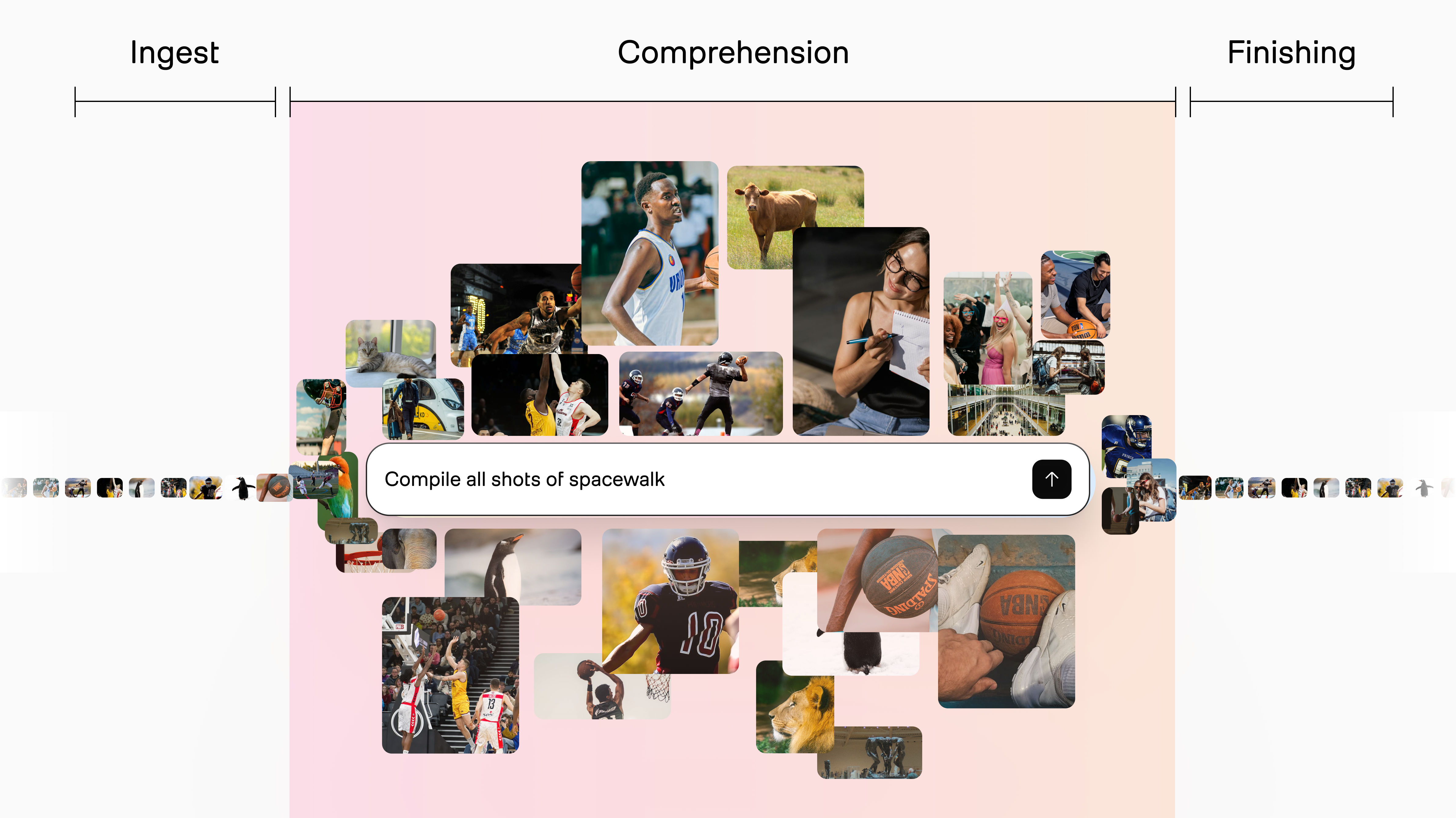
Take a believable mid-size shop: a four-person post team, 12 deliverables a quarter, an average project pulling 40 to 50 hours of raw material across 3 or 4 sources — interviews, b-roll, archival, event capture. The shape of the time is consistent across genres. 10% of total project hours is ingest and organization. 20% is finishing — color, audio, conform, deliverables. The remaining 70% is the comprehension-and-creation band: logging, transcribing, marking selects, building stringouts, watching, scrubbing, re-watching, re-scrubbing.
The senior editor's salary is in that band. The assistant editor's entire job is in that band. The producer's review time is in that band. It is, in P&L terms, the most expensive part of the operation and the least visible on any line item.
This is observable in any shop's timesheet if you look at it honestly. Logging and selection alone routinely consume half the billable hours on a project. On archive-heavy or interview-heavy work, the share climbs past 60%. The launch piece referenced this from the editor's seat. From the operations seat, it's the implicit line item. Comprehension labor is what your editorial team's hourly rate is mostly buying. Knowing how to find clips in video faster is not a workflow preference. It is the P&L question underneath every post-production budget.
The library was always the asset
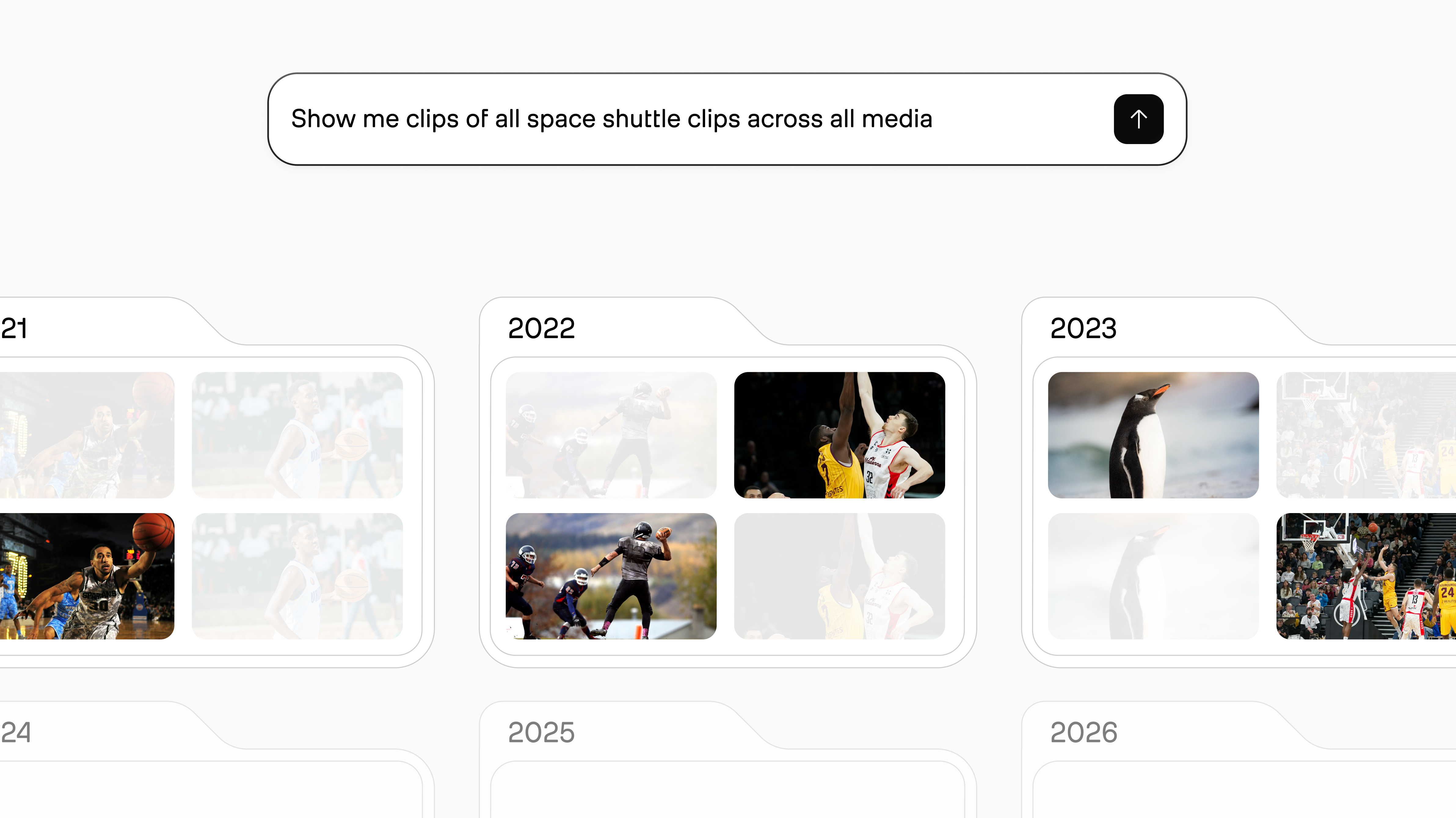
Now widen the lens. The footage your team shot last year is still sitting on your servers. So is the footage from the year before, and the year before that. Most brands and post houses think of that archive the way an accountant thinks of inventory — a fixed cost that depreciates the longer it sits. The honest version is darker. Most archives aren't depreciating. They are invisible. Their value isn't decaying because nobody can see what's in them in the first place.
This is the same shape as dark data in enterprise IT. By the standard estimate, somewhere between 55 and 80% of the information a company collects goes unused, mostly because retrieval is too expensive to justify. Footage is dark data with a higher production cost. Video metadata automation is the first step out of the dark: once footage is indexed by content rather than filename, the archive stops being a cost center and starts being a query.
The producers who have already internalized this are the largest media companies on Earth. The biggest studios are no longer treating their archives as vaults to defend; they are starting to treat them as substrates to open. The major sports leagues spent a decade fighting clip culture before deciding that highlights were the top of a funnel rather than a leak in the bucket. Music labels structure release calendars around the assumption that the fan-cut compilation is a more durable product than the official video. The common thread is the same recognition: the archive is the asset, and access to it is the multiplier on every other piece of the business.
Mid-size post operations and brand content teams are sitting on the same shape of asset at smaller scale. A four-year-old customer interview that nobody has watched since the original use is not a sunk cost. It is a quarterly campaign nobody has run yet. The reason nobody runs it is that finding the right 90 seconds inside 3 hours of conversation costs more than reshooting. AI video analysis for agencies and post houses is the capability unlock that changes that math, turning a retrieval problem into a revenue line.
The capacity math
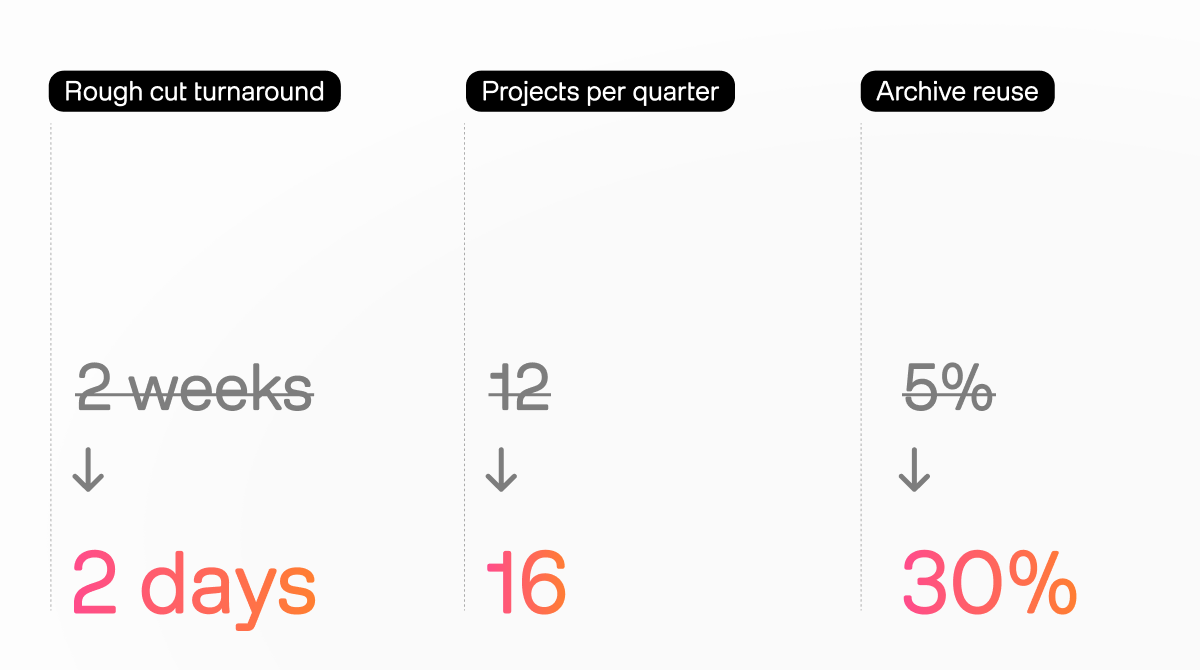
Comprehension getting cheap changes 3 numbers on the same P&L.
The first is capacity. Take the four-person team again. If rough-cut creation drops from 16 hours to 4 — which is about what the workflow looks like on a forty-hour project — total project hours fall by a third. Same team, same headcount, 30% to 40% more deliverables a quarter. The team isn't smaller. The throughput is bigger. For a shop that's been turning down work or staffing up to meet demand, that arithmetic is the whole conversation.
The second is turnaround. The shop that can deliver a rough cut in 2 days instead of 2 weeks is bidding on different work. The fast-turn social campaign, the same-day event recap, the pitch deck for the brand that wants a sizzle by Friday — those briefs go to whoever can credibly say yes. Comprehension cost is the gating function on what kind of work a post operation can take, and most operations have priced it as fixed.
The third is repurposing yield. This is the one that dwarfs the first two. Every brand and post house has footage paid for once and used once. A documentary crew shoots two hundred hours for a feature, finishes the feature, and shelves the rest. A brand spends a quarter producing a customer story and uses it for a single campaign. The reuse rate at most operations is well under ten percent of what's on the drives, not because the material isn't useful, but because finding the useful part costs more than it returns.
Once the archive is searchable — not by filename, not by transcript, but by what is actually happening on screen — AI video intelligence platform turns the customer story shot 18 months ago into the next quarter's sales asset without a reshoot. The all-hands footage becomes a culture video. The product demo from 2 years ago becomes a competitive comparison. Move that reuse rate from 5% to 30% — still conservative once a corpus is genuinely queryable — and you are running a content operation whose unit economics no longer look like a content operation. They look like a software business with a content library.
Comprehension is not generation
The risk story matters here, and it is the part most producers are right to ask about first.
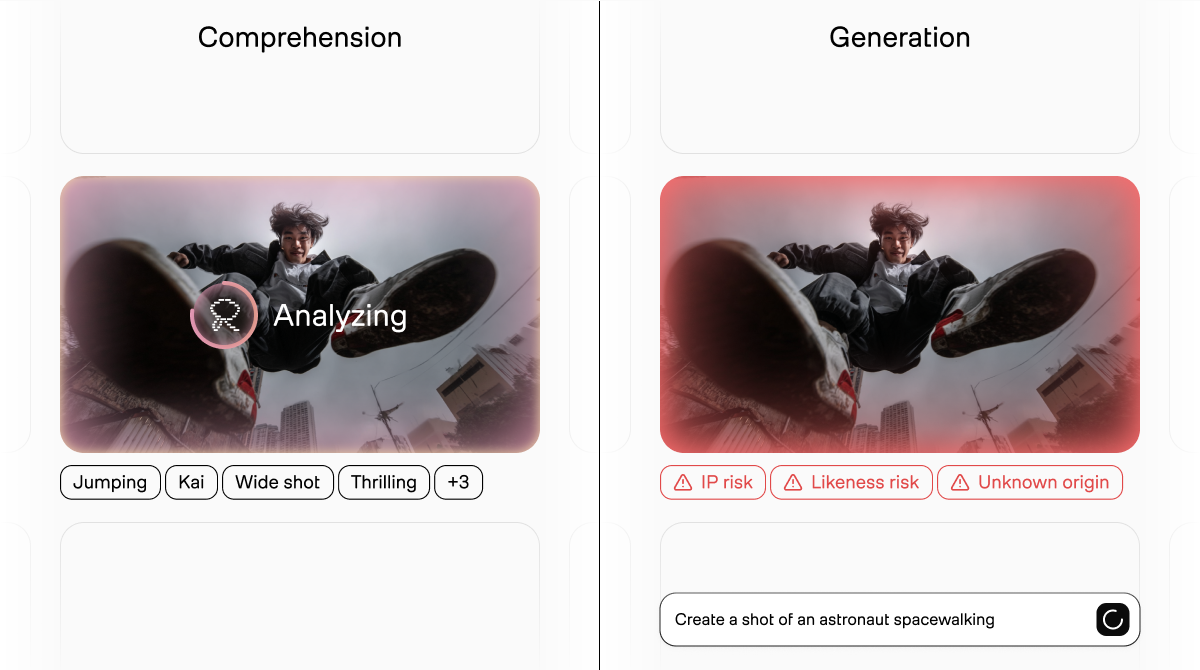
Rodeo is not generating footage. Marengo, TwelveLabs' multimodal video understanding model, is the index — it reads the actual frames, the actual audio, the actual temporal structure of the video your team shot, and returns clips that match what you described. Pegasus, its editorial reasoning layer, reasons over those clips to build a rough cut with editorial structure. There is no synthesized customer speaking words they did not say. No fabricated b-roll of a hospital ward that does not exist. No likeness ambiguity, no compliance flag, no AI-generated face of a real person. The output is the footage you already shot, created in an order that matches your brief.
This distinction is doing more work than it looks like. Half the AI-video conversation right now is about generation — the tools that synthesize footage from a text prompt — and the producer questions that come with it: IP, talent likeness, brand safety, legal exposure, training-data provenance. Rodeo is on the other side of that line. The risk profile of comprehension is the risk profile of a more capable video search tool over assets you already own. The risk profile of generation is something else entirely. Producers who lump them together are paying for a problem they don't have.
The org chart, quietly rewritten
The natural follow-on question — the one a CFO asks after the capacity number lands — is what this does to the team.
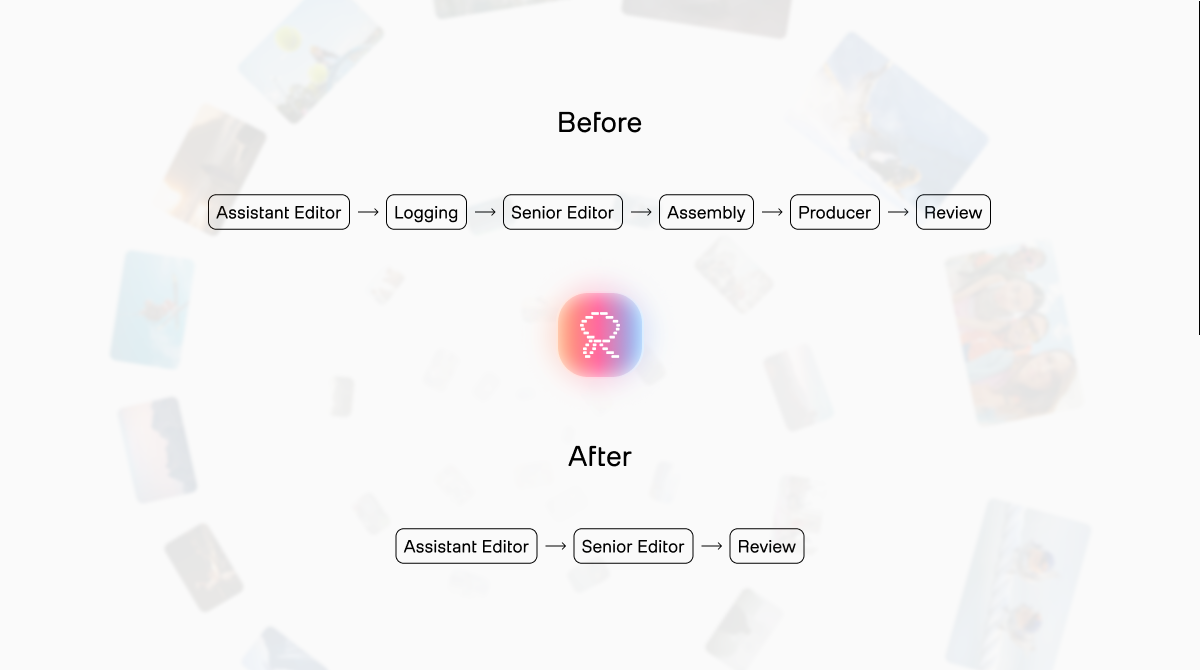
The honest answer is that it changes the work, not the count. The assistant editor whose Tuesday was logging interviews stops doing the work an intern shouldn't be doing either. That time moves into curation — shaping briefs, refining semantic queries, evaluating ranked alternates, sitting closer to the editorial decision. The senior editor's leverage goes up because the comprehension layer hands them a defensible first pass instead of a blank timeline. The producer's review cycles tighten because revisions stop requiring a full re-watch.
This is the same pattern every previous post-production technology has produced. Avid did not eliminate editors in 1989. It eliminated the part of editing that was waiting for the splicer. The comprehension layer is doing the same thing to the part of editing that has been waiting for the watching.
The library you've been treating as a cost is the part of the business with the most operating leverage in it. That has been true for a while. The part that's new is that you can finally see inside. A video intelligence platform like Rodeo is what makes the inside visible.
The Library Premium
Your footage archive is the post-production asset nobody on your P&L has priced. The math changes when comprehension stops being the bottleneck.
The comprehension bottleneck
Most of what your editors do isn't editing.
Walk into any mid-size post-production operation on a Tuesday afternoon and the work in progress looks nothing like the work everyone thinks they're paying for. The assistant editors are not creating. They are logging. The editors are not cutting. They are scrubbing. The producers are not producing. They are watching dailies on 1.5x. Somewhere between 60% and 80% of the hours that flow through a post-production pipeline are not creative labor. They are comprehension labor — the long, quiet, expensive act of figuring out what is in the footage.
This is not new. The shape of post-production was set in 1989, when Avid shipped the first commercial non-linear editor and let editors make cuts without physically splicing tape. Random-access editing reorganized the industry around the assumption that the binding constraint was the cut. Everything since — proxy workflows, networked storage, MAM systems, transcript search — has been a thirty-year project to chip away at that constraint while leaving the deeper one untouched. Comprehension still costs an hour for every hour of footage. The cut got cheap. Watching never did.
The comprehension bottleneck the industry has priced as fixed is now addressable with Rodeo — now generally available. Powered by TwelveLabs, Rodeo is an AI video intelligence platform that understands your footage, so you can go from raw clips to a first cut using plain language without searching, scrubbing, or organizing a single folder. What used to take hours of manual review now takes minutes of structured creation.
Where the hours actually go
Take a believable mid-size shop: a four-person post team, 12 deliverables a quarter, an average project pulling 40 to 50 hours of raw material across 3 or 4 sources — interviews, b-roll, archival, event capture. The shape of the time is consistent across genres. 10% of total project hours is ingest and organization. 20% is finishing — color, audio, conform, deliverables. The remaining 70% is the comprehension-and-creation band: logging, transcribing, marking selects, building stringouts, watching, scrubbing, re-watching, re-scrubbing.
The senior editor's salary is in that band. The assistant editor's entire job is in that band. The producer's review time is in that band. It is, in P&L terms, the most expensive part of the operation and the least visible on any line item.
This is observable in any shop's timesheet if you look at it honestly. Logging and selection alone routinely consume half the billable hours on a project. On archive-heavy or interview-heavy work, the share climbs past 60%. The launch piece referenced this from the editor's seat. From the operations seat, it's the implicit line item. Comprehension labor is what your editorial team's hourly rate is mostly buying. Knowing how to find clips in video faster is not a workflow preference. It is the P&L question underneath every post-production budget.
The library was always the asset
Now widen the lens. The footage your team shot last year is still sitting on your servers. So is the footage from the year before, and the year before that. Most brands and post houses think of that archive the way an accountant thinks of inventory — a fixed cost that depreciates the longer it sits. The honest version is darker. Most archives aren't depreciating. They are invisible. Their value isn't decaying because nobody can see what's in them in the first place.
This is the same shape as dark data in enterprise IT. By the standard estimate, somewhere between 55 and 80% of the information a company collects goes unused, mostly because retrieval is too expensive to justify. Footage is dark data with a higher production cost. Video metadata automation is the first step out of the dark: once footage is indexed by content rather than filename, the archive stops being a cost center and starts being a query.
The producers who have already internalized this are the largest media companies on Earth. The biggest studios are no longer treating their archives as vaults to defend; they are starting to treat them as substrates to open. The major sports leagues spent a decade fighting clip culture before deciding that highlights were the top of a funnel rather than a leak in the bucket. Music labels structure release calendars around the assumption that the fan-cut compilation is a more durable product than the official video. The common thread is the same recognition: the archive is the asset, and access to it is the multiplier on every other piece of the business.
Mid-size post operations and brand content teams are sitting on the same shape of asset at smaller scale. A four-year-old customer interview that nobody has watched since the original use is not a sunk cost. It is a quarterly campaign nobody has run yet. The reason nobody runs it is that finding the right 90 seconds inside 3 hours of conversation costs more than reshooting. AI video analysis for agencies and post houses is the capability unlock that changes that math, turning a retrieval problem into a revenue line.
The capacity math
Comprehension getting cheap changes 3 numbers on the same P&L.
The first is capacity. Take the four-person team again. If rough-cut creation drops from 16 hours to 4 — which is about what the workflow looks like on a forty-hour project — total project hours fall by a third. Same team, same headcount, 30% to 40% more deliverables a quarter. The team isn't smaller. The throughput is bigger. For a shop that's been turning down work or staffing up to meet demand, that arithmetic is the whole conversation.
The second is turnaround. The shop that can deliver a rough cut in 2 days instead of 2 weeks is bidding on different work. The fast-turn social campaign, the same-day event recap, the pitch deck for the brand that wants a sizzle by Friday — those briefs go to whoever can credibly say yes. Comprehension cost is the gating function on what kind of work a post operation can take, and most operations have priced it as fixed.
The third is repurposing yield. This is the one that dwarfs the first two. Every brand and post house has footage paid for once and used once. A documentary crew shoots two hundred hours for a feature, finishes the feature, and shelves the rest. A brand spends a quarter producing a customer story and uses it for a single campaign. The reuse rate at most operations is well under ten percent of what's on the drives, not because the material isn't useful, but because finding the useful part costs more than it returns.
Once the archive is searchable — not by filename, not by transcript, but by what is actually happening on screen — AI video intelligence platform turns the customer story shot 18 months ago into the next quarter's sales asset without a reshoot. The all-hands footage becomes a culture video. The product demo from 2 years ago becomes a competitive comparison. Move that reuse rate from 5% to 30% — still conservative once a corpus is genuinely queryable — and you are running a content operation whose unit economics no longer look like a content operation. They look like a software business with a content library.
Comprehension is not generation
The risk story matters here, and it is the part most producers are right to ask about first.
Rodeo is not generating footage. Marengo, TwelveLabs' multimodal video understanding model, is the index — it reads the actual frames, the actual audio, the actual temporal structure of the video your team shot, and returns clips that match what you described. Pegasus, its editorial reasoning layer, reasons over those clips to build a rough cut with editorial structure. There is no synthesized customer speaking words they did not say. No fabricated b-roll of a hospital ward that does not exist. No likeness ambiguity, no compliance flag, no AI-generated face of a real person. The output is the footage you already shot, created in an order that matches your brief.
This distinction is doing more work than it looks like. Half the AI-video conversation right now is about generation — the tools that synthesize footage from a text prompt — and the producer questions that come with it: IP, talent likeness, brand safety, legal exposure, training-data provenance. Rodeo is on the other side of that line. The risk profile of comprehension is the risk profile of a more capable video search tool over assets you already own. The risk profile of generation is something else entirely. Producers who lump them together are paying for a problem they don't have.
The org chart, quietly rewritten
The natural follow-on question — the one a CFO asks after the capacity number lands — is what this does to the team.
The honest answer is that it changes the work, not the count. The assistant editor whose Tuesday was logging interviews stops doing the work an intern shouldn't be doing either. That time moves into curation — shaping briefs, refining semantic queries, evaluating ranked alternates, sitting closer to the editorial decision. The senior editor's leverage goes up because the comprehension layer hands them a defensible first pass instead of a blank timeline. The producer's review cycles tighten because revisions stop requiring a full re-watch.
This is the same pattern every previous post-production technology has produced. Avid did not eliminate editors in 1989. It eliminated the part of editing that was waiting for the splicer. The comprehension layer is doing the same thing to the part of editing that has been waiting for the watching.
The library you've been treating as a cost is the part of the business with the most operating leverage in it. That has been true for a while. The part that's new is that you can finally see inside. A video intelligence platform like Rodeo is what makes the inside visible.